

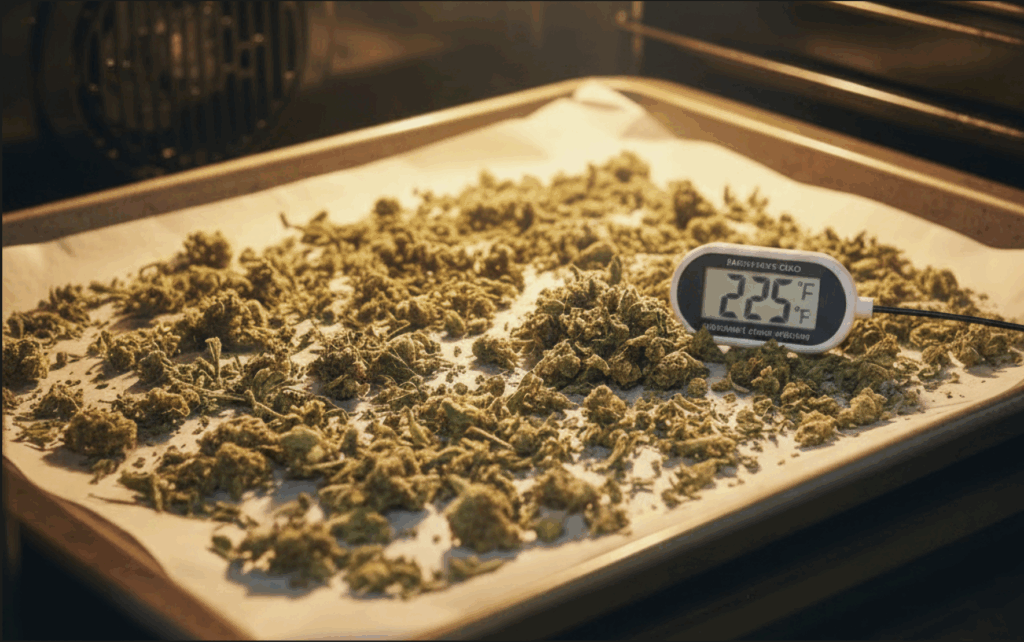
Decarboxylation, aka decarbing, is a heat-driven chemical reaction that activates cannabinoids, converting their inactive acid forms (THCA and CBDA) into psychoactive THC and CBD. By activating these compounds, you can infuse cannabis into oils, butters, or other fatty binders for later use.
Have you ever wanted to try making edibles at home, but have no idea how to actually infuse the weed and its effects into the food you are making? Lucky for you, decarbing is easy to do at home with the right tools and techniques.
Why Decarbing Matters
Raw cannabis contains THCA (tetrahydrocannabinolic acid), CBDA (cannabidiolic acid), and CBGA (cannabigerolic acid) – not THC or CBD. These acidic compounds aren’t psychoactive, which is why eating raw flower does nothing.
Heat removes the carboxyl group from these molecules, converting them into their active forms: THC, CBD, and CBG. This process is called decarboxylation, and it’s essential for any cannabis-infused recipe to work.
What You Need
- Dry cannabis flower (coarsely ground)
- Oven
- Baking sheet
- Parchment paper or aluminum foil
- Binding agent (High fat – like avocado oil, jojoba oil, or ghee)
- Double boiler
- Cheesecloth and funnel (optional)
- Storage container (mason jar recommended)
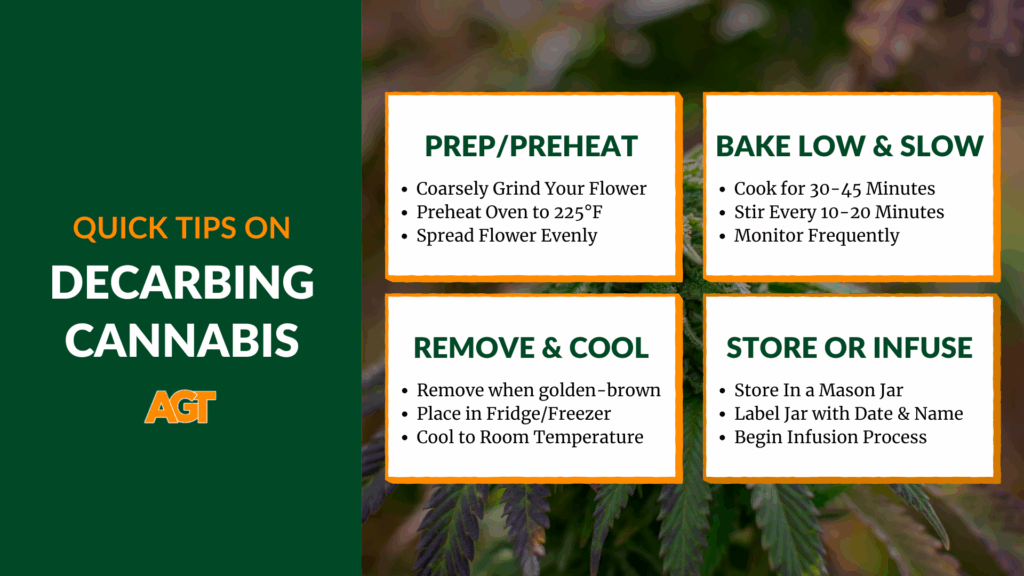
How to Decarb Cannabis
1. Prep & Preheat
Set your oven to 225°F (anywhere from 200ºF-240ºF works, the lower the better – it helps preserve those terpenes). While your oven is preheating, place a layer of parchment paper or foil on your baking sheet. Then, coarsely grind or break up your flower into pea-size pieces, as uniform in size as possible, and spread it evenly across the sheet.
2. Bake Low & Slow
Once your oven reaches temp, slide the baking sheet onto the middle rack and set a timer for 30-45+ minutes (longer if you’re using a lower temp, 2-3 hours at 200ºF).
Every 10-20 minutes, gently shake the baking sheet around to ensure the flower is being evenly heated. You want to remove the flower when it is dry, golden-brown, and fragrant. Expect a strong aroma – make sure you have good airflow/ventilation.
3. Remove & Cool
Once your timer runs out, remove the baking sheet from the oven and let it cool to room temp, another ~30-45+ minutes. You can also transfer the baking tray to a fridge or freezer to speed up the process.
4. Store or Infuse
At this point, you’ve activated the cannabis. Store it in an airtight container labeled with “decarbed” and the date, or start to infuse.
Alternative Ways to Decarb
Stovetop Method
Submerge your raw flower into a saucepan with your binding agent. Gently heat the pan on your stovetop while closely monitoring the temperature, making sure it doesn’t exceed 240°F (can damage the potency of the flower).
After about 45 minutes, your cannabis should be fully decarbed. From there, pass the mixture through a mesh strainer or cheesecloth and into a mason jar for storage.
Sous Vide Method
You can also decarb your weed using hot water. We recommend using a sous vide machine if you are going with this method, but you can technically “poach” your flower without one.
Place the flower in a heat-safe plastic bag (vacuum-sealed or zip-top with air removed). Submerge in water heated to 200°F using a sous vide machine or monitored stovetop pot. Weigh the bag down to keep it fully submerged. After 90 minutes, remove, cool, and dry the bag before storing.
Each method has its trade-offs, so use what works best for your situation – don’t be afraid to test different techniques!
Infusing Your Decarbed Cannabis
Once you’ve decarbed your weed, it’s time to put it to use. A key part of successfully infusing your weed is choosing a base that contains a high level of fat. Because active THC and CBD are lipophilic, they bind to fats and alcohols, rather than water.
Choosing a high-fat base is critical for absorption and effectiveness.
Choosing Your Base
Here are some common bases and their recommended uses:
| Fat Type | Recommended Use |
|---|---|
| Coconut Oil (Regular or MCT) | Brownies, gummies, tinctures |
| Butter (Clarified or Unsalted) | Baked goods, savory dishes |
| Olive Oil | Dressings, cooking oils |
| Avocado Oil | Cooking or sautéing |
| Ghee | Curries, baked goods |
Calculating Concentration
Knowing the potency of your infusion prevents under- or over-dosing. Start with your flower’s THC percentage (usually listed on dispensary packaging).
Example: 1 gram of flower at 75% THC contains 750mg THC total. Account for 70-80% decarb efficiency: 750mg × 0.75 = ~560mg active THC.
If you infuse that into 2 cups of oil, each cup contains roughly 280mg THC. Divide further by how many servings your recipe makes to calculate per-serving dosage.
The Infusion Process
Infusing is all about using low, consistent heat over time (sound familiar)? We recommend using a double boiler to maintain consistent, gentle heat without burning. For larger batches, a slow cooker works well.
To start infusing, use your double boiler – fill the bottom layer with water and bring it to a gentle simmer (medium-low heat). In the top layer, combine your high-fat base with your decarbed weed. This is where the calculations come into play – it gets the infused oil to your ideal potency.
The cook time for infusion can vary depending on your desired strength. Here is a quick breakdown of the different cook times:
| Strength | Time | Result |
|---|---|---|
| Mild | 1.5-2 hrs | Lighter potency and flavor |
| Medium | 2-3 hrs | Balanced |
| Strong | 3-4 hrs | Max extraction, more “green” flavor |
Remember to stir the mixture periodically to get an even infusion and ensure your base doesn’t burn. Keep an eye on the water level of your bottom layer as well.
Strain & Separate
Once your flower is successfully infused into the oil, it’s time for the final step: separation.
- Allow your oil to cool for at least 10-15 minutes
- Line your funnel (if using) with the cheesecloth and place a mason jar or bowl underneath.
- Slowly pour the mixture through the cheesecloth.
- Gently squeeze the cheesecloth to extract the oil without letting any flower pieces fall through (too much pressure can push unwanted compounds into the oil, which will give it a bitter or grassy flavor)
Allow the oil to fully cool before sealing, labeling, and storing. We’ve found that canna-butter typically lasts ~2 weeks in the fridge and up to 6 months frozen, while canna-oil lasts 1-2 months in the pantry and 6+ months refrigerated.
Watch Out for:
1. Too Much Heat or Overcooking
When temperatures exceed 240°F, the THC in your bud begins to degrade into cannabinol (CBN, a less psychoactive compound than THC that often has more sedative properties).
Higher temperatures can also destroy terpenes, which is thought to contribute to the effects and flavor of cannabis.
Easy Fixes:
- Use an oven thermometer
- Stay in the 200ºF-240°F range
- For infusions, keep temp at 160ºF-200°F max.
- Set timers and avoid multitasking while cooking.
- When in doubt, choose a lower temperature and longer time.
2. Uneven Heating
If you didn’t evenly spread out your flower before heating or failed to stir/mix it while heating, some sections of the baking sheet will decarb faster than others, leading to inconsistent dosing and potency.
Easy Fixes:
- Break up the flower evenly (pea-sized) before decarbing.
- Shake around periodically while baking.
- Use baking sheets, not deep dishes, so heat distributes evenly.
- For stovetop methods, stir every 20-30 minutes to circulate cannabinoids through the fat.
3. Not Using A Proper Base
Cannabinoids are fat-soluble, so choosing a proper base is vital to making an effective infusion. If you try to add decarbed weed directly into recipes or use an improper base, your body won’t be able to absorb the cannabinoids because they are unable to bond with anything.
Easy Fixes:
- Infuse decarbed cannabis into a high-fat medium (like avocado oil, jojoba oil, coconut oil, olive oil, ghee, or butter).
- Mix thoroughly and simmer on low heat to ensure complete bonding.
- Always infuse your decarbed weed before adding it to recipes
4. Skipping Decarboxylating
If you skip decarboxylation, your cannabis stays in its inactive form (THCA and CBDA) so you won’t feel its effects, no matter how much oil, butter, or even cannabis you use.
Easy Fixes:
- Always heat your cannabis before infusing
- Gently activate your concentrations (around 200-240°F).
Don’t rush through this step. Decarboxylating your weed is the most important part of getting the results you want.
5. Not Calculating Dosage
It’s easy to over- or undershoot your desired effect if you don’t calculate your dosage.
Use this formula:
THC (mg) = weight of cannabis (g) × %THC × 1,000 / batch size (in servings)
Using Your Infusion
Now that you’ve made canna-oil, here are a couple of recommendations on using it.
Edibles
Edibles are probably the most common use for infused oils and butters. While your canna-butter or canna-oil may slightly change the original flavor of your baked good or gummy, it’s a tried-and-true way to experience your high.
Edibles have slightly different timings and effects due to the absorption being through ingestion rather than inhalation. When taking edibles, effects commonly take anywhere from 30 minutes to 2 hours to appear and can last between 6-12 hours on average.
*Individual experiences with cannabis may vary depending on factors such as history of usage, type/dosage, and personal biology. Always consult with a healthcare professional before using cannabis products for medical purposes.
Tinctures
Tinctures are typically made with an alcohol base and are more concentrated than other forms of infusions. These tinctures can be ingested orally or used topically.
Traditionally, herbalists have used tinctures for everything from stress relief to immune support and digestive health. Though it’s not uncommon to mix them with your favorite food or drink.
Topicals
Topicals are soothing salves, balms, or lotions designed to be absorbed by your skin. These are usually comprised of a canna-oil, essential oils, and a soothing base such as beeswax or shea butter. Topicals are great for localized relief, especially for inflammation or pain.
Your Infusion, Your Way
By gently heating your flower, you activate cannabinoids like THC and CBD, making them ready to infuse into oils, butters, or other fat-based carriers. Once infused, that base becomes the foundation for endless creations, like edibles, tinctures, or topicals, each offering a customized and potent experience. Whether you’re after a calming high or a creative project in the kitchen, understanding decarboxylation puts you in full control of your cannabis experience.
A Greener Today is here to help you make the most of your next project with premium cannabis products, expertly curated strains, and knowledgeable staff who understand quality. From flower to concentrates and everything in between, we have the variety and value you need to elevate your at-home infusions with confidence.
The information in this article is for educational purposes only and is not intended as medical advice. Research on cannabis terpenes is ongoing, and many of the potential benefits described are based on preliminary or preclinical studies. Individual experiences with cannabis may vary depending on factors such as product type, dosage, and personal biology. Always consult with a healthcare professional before using cannabis products for medical purposes. A Greener Today makes no claims regarding the diagnosis, treatment, cure, or prevention of any disease.