
The information in this article is for educational purposes only and is not intended as medical advice. Individual experiences with cannabis may vary depending on factors such as product type, dosage, and personal biology. Always consult with a healthcare professional before using cannabis products for medical purposes. A Greener Today makes no claims regarding the diagnosis, treatment, cure, or prevention of any disease.
The Short Answer: The relationship between cannabis and weight is more complicated than you’d expect. Despite weed’s reputation for causing the munchies, research shows that regular cannabis users tend to have lower BMI and lower obesity rates than non-users.
If you’ve ever finished a smoke session and raided the fridge, you’re not alone. Cannabis is famous for stimulating appetite, so it seems logical that marijuana use would lead to weight gain. But the data tells a different story.
Multiple large-scale studies have found that people who use cannabis regularly tend to weigh less than those who don’t. It’s a paradox that researchers have been trying to explain for years, and while we don’t have all the answers yet, the science offers some interesting clues.
We’re not here to sell cannabis as a weight loss solution. Instead, we’ll walk through what the research actually says about cannabis, metabolism, and body weight, and what it doesn’t.
The Munchies Paradox
Let’s start with what we know for sure: cannabis can make you hungry. THC, the psychoactive compound in marijuana, binds to cannabinoid receptors in the brain that regulate appetite and food intake. This triggers the familiar urge to eat, even if you weren’t hungry before your session.
So if weed increases appetite, why do studies keep showing that regular cannabis users have lower body weight? That’s the munchies paradox.
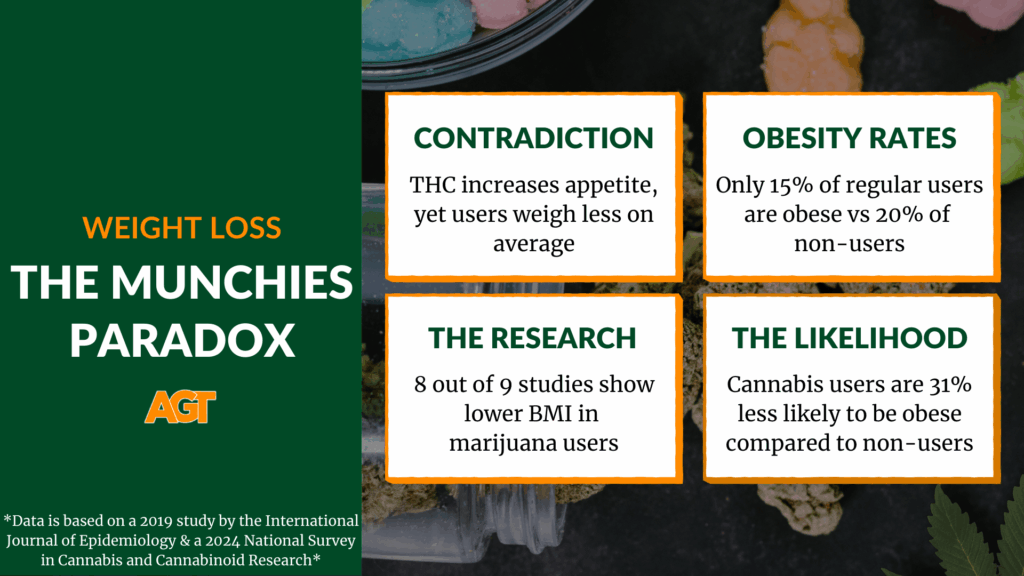
Researchers have been scratching their heads over this for years. A 2019 study published in the International Journal of Epidemiology followed over 33,000 participants and found that only 15% of persistent cannabis users were obese, compared to 20% of non-users. A more recent 2024 national survey of over 735,000 U.S. adults found similar results, with cannabis users being 31% less likely to be obese than non-users.
The increased appetite is real. But something else appears to be happening in the body that offsets the extra calorie intake, and scientists have a few theories about what that might be.
The Endocannabinoid System and Metabolism
To understand why cannabis might affect body weight, it helps to know a little about the endocannabinoid system.
The endocannabinoid system (ECS) is a network of receptors that helps regulate appetite, energy storage, and metabolic rate. The two main cannabinoid receptors are CB1 and CB2. When you consume cannabis, THC binds to CB1 receptors in the brain, which is why it triggers hunger.
Here’s where it gets interesting. Some researchers believe that regular cannabis use may cause CB1 receptors to downregulate over time, meaning they become less sensitive. This could reduce the body’s tendency toward energy storage and weight gain, even if calorie intake stays the same.
Animal studies support this theory, but human research is still limited. The endocannabinoid system remains a key area of interest for scientists studying the cannabis-weight connection.
What the Research Says
The connection between cannabis use and lower body weight isn’t based on a single study. It’s a pattern that shows up again and again across different research methods and populations.
The Data So Far
A 2018 meta-analysis published in Cannabis and Cannabinoid Research reviewed nine studies on the topic and found that eight of them showed an inverse relationship between cannabis use and BMI. The review also found that:
- The average BMI of cannabis users fell within the healthy weight range
- Non-users averaged in the overweight category
- Two studies found that longer duration of use correlated with even lower BMI
Other large-scale studies have reported lower obesity rates among marijuana users even after adjusting for factors like age, gender, income, and tobacco use. Some research has even found that people who use cannabis regularly gain less weight over time than non-users, despite reporting higher caloric intake.
What We Still Don’t Know
Here’s the important caveat: correlation isn’t causation. These studies show an association between cannabis use and lower weight, but they don’t prove that weed is the reason. It’s possible that other lifestyle factors, behaviors, or even genetics could explain the connection.
Most of the research so far has been observational, meaning scientists are looking at patterns in existing data rather than running controlled clinical trials. Until more rigorous studies are done, we can’t say for certain what’s driving these results.
THC, CBD, and Appetite
Not all cannabinoids affect appetite the same way. The terpenes and cannabinoids in your cannabis work together to shape your experience, and that includes how hungry you feel.
THC is the psychoactive compound responsible for the munchies. It binds directly to CB1 receptors and stimulates hunger, which is why medical marijuana is sometimes prescribed to cancer patients or others who need help maintaining their appetite.
CBD works differently. It doesn’t bind to CB1 receptors in the same way, and research suggests it may actually have the opposite effect. A systematic review of clinical trials found that CBD was more often associated with decreased appetite than increased hunger.
What About THCV?
THCV (tetrahydrocannabivarin) is a lesser-known cannabinoid that’s sometimes called “diet weed.” Unlike THC, THCV acts as an antagonist on the CB1 receptor, which means it may suppress appetite rather than stimulate it. In rodent studies, THCV decreased appetite, increased satiety, and boosted metabolic rate. Human research is still limited, but it’s an area of growing interest for those curious about cannabis and metabolism.
The bottom line: the cannabinoid profile of your cannabis strain could influence how it affects your appetite. If you’re curious about strains with different THC, CBD, or THCV ratios, a budtender can help point you in the right direction.
What Cannabis Won’t Do
While the research on cannabis and weight is intriguing, it’s important to keep expectations in check.
Cannabis is not a weight loss drug. No study has shown that using weed will reliably help you shed pounds, and no medical professionals are recommending it as a treatment for obesity. The connection between cannabis use and lower BMI is an observed pattern, not a proven cause-and-effect relationship.
There are also potential risks to consider. THC increases appetite, and if you’re regularly reaching for snacks during or after a session, those extra calories can lead to other issues. Relying on cannabis for weight management isn’t supported by science, and it’s not a substitute for the basics: a balanced diet, regular exercise, and consistent physical activity.
If you have a medical condition related to weight, metabolic disorders, or insulin resistance, talk to a doctor before making any changes to your routine. Cannabis may interact with other treatments, and what works for one person may not work for another. Cannabis might play a role in how your body processes energy, but it’s not a quick fix.
The Bottom Line
The connection between cannabis and body weight is real, but it’s not fully understood.
Studies consistently show that regular cannabis users tend to have lower BMI and lower obesity rates than non-users. Researchers believe the endocannabinoid system plays a role, and there’s growing interest in how different cannabinoids like THC, CBD, and THCV affect appetite and metabolism in different ways.
But correlation isn’t causation. We don’t yet have clinical trials proving that cannabis directly causes weight loss, and the studies we do have are mostly observational. More research is needed before anyone can make definitive claims.
If you’re a cannabis user curious about this topic, the best approach is still the basics: a healthy diet, regular physical activity, and mindful consumption. Pay attention to how different strains affect your appetite and energy levels, and don’t expect cannabis to do the heavy lifting for you.
A Greener Today carries a wide selection of flower, concentrates, and products to fit your lifestyle. Stop by or shop online to find what works for you.
The information in this article is for educational purposes only and is not intended as medical advice. Individual experiences with cannabis may vary depending on factors such as product type, dosage, and personal biology. Always consult with a healthcare professional before using cannabis products for medical purposes. A Greener Today makes no claims regarding the diagnosis, treatment, cure, or prevention of any disease.